05 Dec

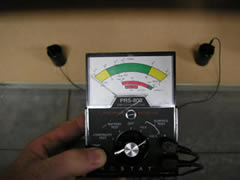
Ground Rod-to-earth resistance

Q: What should be the required Ground Rod-to-earth resistance? is it less than 2ohms or less than 25ohms?

A: I am going to consult my document on Grounding-For the Protection of Electrostatics Discharge Susceptible Items (ANSI/ESD S6.1-2005), an ESD Association standard.  I am assuming that your inquiry is to provide the bonding and grounding for the prevention of ESD in an EPA (ESD Protected Area).

From the Main(s) service equipment or AC Mains, you have the Hot or Black conductor (Let’s assume AC Single Phase 120v) from the Circuit breaker panel, then you have the Neutral or white conductor coming from the Neutral bus, then you have the Equipment grounding conductor or green conductor.  The black or Hot conductor comes from a circuit breaker and goes to an AC outlet receptacle.  The white or Neutral conductor comes from a neutral bus which is bonded to an earth grounding electrode and goes to an AC outlet receptacle.  The green conductor or equipment grounding conductor comes from a ground bus and is bonded to the metal chassis or conduit.  The ground bus is then bonded to the Neutral bus.  The common point ground or bus bar is connected or bonded to this ground connection, as is various other ESD technical elements (the grounding conductors or wires from wrist straps, worksurfaces, flooring or floor mats, tools, fixtures, storage units, carts, chairs, garments, etc). 

The impedance of the equipment grounding conductor or receptacle ground to the common point ground or ESD technical element shall not be greater than 1 ohm (Ω).  I see no mention of 2 ohms (Ω) in this document, although it is noted that the ground resistance values objectives vary from industry to industry.  The telecommunications industry has often used 5 ohms or less as their value for grounding and bonding.  The goal in grounding resistance values is to achieve the lowest ground resistance value possible.  The National Electrical Code defines a ground as: “a conductive connection, whether intentional or accidental between an electrical circuit or equipment and the earth, or to some conducting body that serves in place of the earth.”  The purpose of a ground besides the protection of people and equipment is to provide a safe path for the dissipation of Fault Currents, Lightning Strikes, Static Discharges, EMI and RFI signals and Interference.

The reference to 25 ohms refers to facilities with AC Equipment Ground and Auxiliary Ground (A separate supplemental grounding conductor for use other than general equipment grounding) per ANSI/ESD S6.1-2005 6.3.2.  The auxiliary ground shall be bonded to the AC equipment ground when possible.  The AC equipment and the ESD technical elements might be at different potentials.  The auxiliary ground needs to be bonded to the equipment ground to ensure that there is no difference in electrical potential between the two systems.
05 Dec

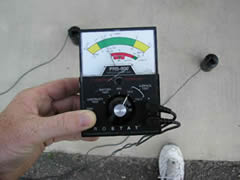
Assuring the flooring is anti-static.

Q: We always face a problem of selling your anti-static/dissipative vinyl floors to our clients. What is the solution for client satisfaction if they want to make sure the vinyl floor is anti-static or not and if the vinyl floor works as a dissipate of current.

A: The ESD vinyl flooring that we sell, service, and install is typically manufactured from a permanently conductive, non-humidity dependant blend of conductive additives interspersed with a pure virgin solid vinyl.

Our tile is specified as static conductive (2.5E04 Ω to 1E06 Ω) or static dissipative (1E06 Ω to 1E09 Ω). The term antistatic typically refers to a range of resistance outside of industry accepted standards for ESD flooring. There are some commercial and residential applications where antistatic flooring is acceptable but would be outside of the range of Static Conductive or Static Dissipative. Antistatic often refers to products used in packaging or where materials that resist tribocharge but aren’t necessarily conductive enough to bleed off charges to ground in a timely fashion.

Attachment of a typical GZ flooring system to an existing substrate is typically accomplished via GZ-C2000-4R releasable liquid conductive fiber-loaded adhesive. There are a variety of adhesives for various types of application. Grounding of an ESD flooring system is comprised of appropriately placed copper grounding tape running beneath flooring overlayment adhesive and attached to primary electrical building grounds located throughout the facility, as well as installation of GZ- ground plates. The primary electrical building grounds serve as the Common Point Ground or are bonded to the CPG for the ESD flooring (ESD technical element) and comply with ANSI/ESD S6.1-2005 as per ANSI/ESD S20.20-1999.

05 Dec

Wrist straps according to EOS/ESD standards.

Q: We have an ESD tile floor in our testing lab. During a recent AS9100 audit we were asked why we don’t use wrist straps. Since our ISO9100 & 2 certified calibration provider only uses them when they have to certify the repair of a system and we don’t do that do we need more than the flooring? (booties, straps, etc.)

A: The answer to your question is, YES. In accordance to EOS/ESD standards, an ESD floor in conjunction with Heel Grounders, ESD Booties, ESD Foot Wear does NOT take the place of using Personnel grounded Wrist Straps at the workstation. So the basic ESD program would include the technician wearing a Wrist Strap.

Protective personnel grounding products such as; heel straps, booties and shoes working in conjunction with an ESD floor are designed for processes within your ESD program where the technician has to be mobile within an ESDPA, (ESD Protected Area) where the electrostatic sensitive device is not protected in an ESD protective container or shielded in some manner, e.g. ESD Bag, Bin, Tote, Box, Tray, Container, etc.

If your process has technical personnel setting or standing at a workstation they DO require grounding via a Wrist Strap. So one doesn’t necessarily take the place of the other, and both may be required depending on your personnel and their mobility throughout the plant.

If your technical staff removes their wrist strap to transport an ESD sensitive device or component outside the ESD protected area, the device also needs to be shielded as well as the technician being properly outfitted with ESD shoes, booties or heel straps. Within the ESDPA, they do require the additional shielding protection of the device, but it is always a good idea when practical.

I hope this helps address your question, please let us know if we can be of further assistance with any ESD questions or ESD protective product requirements you and your team may be sourcing.

05 Dec

Conductive flooring in an "explosive" environment.

Q: We are an explosives manufacturer and are looking to repaint our conductive flooring. We subscribe to the standard NFPA requirements for conductive flooring. What is the best and most economical product to apply? Consider that the environment would be expected to be consistently wet.

A: We recommended (2) possible options, both of which would be completely monolithic and seamless due to the excessive liquids that will be present.
Anytime that you have explosives present, the floor will have to be “sparkproof” and fall into a conductive range, verses static dissipative.
These are the two most important criteria for recommending a system for this environment.

Out of these (2) systems, a conductive epoxy is going to be most cost effective, verse a thermally heat welded conductive vinyl system.

Always best to consider a “professional” or approved factory installation for warranty consideration as well as certification that the floor meets the customers expectations and is actually going to get the job done.

05 Dec

How important is humidity in the control of electrostatic problems?

Q: How important is humidity in the control of electrostatic problems? What is the approximate decrease in electrostatic control if the humidity is reduced from 50% to 35% RH?

A: I have linked a white paper below for your review that puts this topic into perspective.

This data seems most relevant in this case, because it points out how well humidity from 30% and up reduced tribo-charging, but not good enough for the thin-film applications. Notice that voltages of up to 1.5 kV are still generated with ease in an 80% environment! Dropping from 50% to 35% might be beneficial to prevent corrosion, but still require an EPA (ESD PROTECTED AREA) with a total ESD protection system.
Download White Paper (PDF Reader Required)

05 Dec

Ben-Top Ionizer and decay time vs. effective distance

Q: I have one question/problem that I would like to ask regarding an experiment to test a bench top air ionizer. From the attached documents, there are 2 graphs of decay time versus effective distance, one for decay time on negative charges and the other one for decay time on positive charges. As you can see, the closer the bench top air ionizer (effective distance), the lesser the decay time will be. My question is, why is it during the distance of 20 to 24 inch the graph line become a straight line (saturated) and not growing linearly like the other points?

A: I see you’re using the Bench Top style air ionizer. The “PC” means that it is “targeted” coverage as opposed to “extended” coverage. The posted operating range appears to be from 1′ x 5′ or 12″ to 60″.

Your graphs range in distance from 4″ to 32″. I’d consider using a test method recommended by EOS/ESD S3.1 if you haven’t already.

Was your humidity really at 80%?

This ionizer also has a heater function. I’m not familiar with that particular feature, whether or not it is a factor here.

Ionizers have two properties that ANSI EOS/ESD S3.1-2000 defines through the use of a CPM; discharge time and offset voltage.

Ionizers increase the electrical conductivity of air, which is especially useful in environments that use insulators which cannot be removed from the EPA (such as PC boards). Grounding an insulator doesn’t remove it’s electrostatic charge. They also reduce the effect of the earth’s field, which increases with the altitude above the work surface of the DUT(device under test).

Now things get complicated.
Discharge time:
Ionizers decrease the charge on the CPM exponentially with the time constant RC.
R = resistance of air (Keep in mind that air resistance increases with the distance that ions must travel).
C = capacitance of the plate. ( Keep in mind that smaller objects have lower capacitance and the time to discharge them maybe shorter than the discharge time).

Offset Voltage:
This deals with induced potential on objects. It has been found that the mobility of negative and positive ions are different. Thus, there is a small electric field generated which is zero at the work bench surface (if dissipative ESD mats are being used) and largest as you get closer to the ionizer. We use an isolated system, which reduce this effect by a simple law of nature- charge cannot be created or destroyed in an isolated system. With the more sensitive devices, such as an MR head on a disk-drive, I’d be very careful here as no system is perfect. Will electrical potential damage a device, or will the rate of current discharge do the damage?

Unfortunately, there’s other things involved with your chart, such as the mere dimensions of your plates and the distance from them. Really close to the plates, the effects of decay time are linear and are affected by a plane source. Further out to some point, you may be dealing with a line source which drops off as the function of L/2 where L = length from the plate, and ultimately, when you get 7 times that length or 7L, you are dealing with an inverse square or L / 4 equation- or point source- out there you are parallel to the source or detector. An example of this equation is to calculate the surface area of a sphere with a diameter of 2 units as opposed to one with a diameter of 4 units. Suffice to say, nature is too complicated to be linear.

I’ve only scratched the surface on your question here and I’d like to give it more thought. I’d run the experiment myself here, but I currently have some equipment in for calibration. For now, let’s move in the direction of testing per EOS/ESD S3.1.

05 Dec

Which is best: Epoxy or Vinyl and Conductive or Dissipative?

Q: We are removing old vinyl tile and replacing with ESD protective tile. We are wondering if ESD conductive or dissipative is best. Our business is dehydration baking, final functional testing and packaging semiconductor IC’s with design circuits typically in .25 micron range. We need recommendations on conductive vs. dissipative and epoxy vs vinyl tile. The area is not high traffic. Thanks.

A: Good questions. In selecting an electrical range there are several key factors to consider, these are in order of importance in our professional opinion:

  1. Device sensitivity?
  2. Does the type of work being performed in the protected area include, working with Power Supplies?
  3. Is your staff going to be wearing personnel grounding protection?
  4. Are there any environmental conditions to consider?
  5. How important is meeting industry standards to you and your company? e.g.
    • EOS/ESD S7.1
    • ANSI/ESD S20.20
    • ISO Compliance
    • In-House Standards
    • Customer Contract Standards

Based on what you have described in you e-mail, conductive range is best suited for your application, dissipative should not be considered. See the attached white paper on this specific subject. As this particular document has even been published yet, please keep this document confidential for your internal use only.

The factors that should be considered in choosing a Material Type are as follows:

  1. What is the intended use for the floor? What type traffic will the floor see? Will liquids or spills be anticipated or utilized in this area? Do you own or lease the building? Will odors be a problem during the installation process? Are you fully operational and or will the work be done in phases? Budgetary factors Performance warranty Maintenance level expectations
  2. Esthetics

I think this will give you some things to consider moving forward. Please see the attached floor comparisons chart for additional things you should consider, this chart may prove helpful to you and your team. Let us know if we can provide you with flooring sample submittals, product specification sheets, quotations, etc. I would like to talk to you in greater detail regarding Epoxy vs. Tile, we have many millions of square feet of experience in this category, so please call me when you have some time.

Please let us know how we can better support you and your company moving forward, as your satisfaction is our highest priority!
See also: ESD Open Forum(PDF); ESD Flooring Comparison Chart(PDF)

05 Dec

Cleaning an ESD Floor

Q: How do you clean the floor, can it be waxed, and if so what type of wax?

A: All our ESD Dissipative and Conductive floors are designed to be wax free, low maintenance with permanent electrical properties. We recommend daily sweeping and damp mopping with our “ZeroStat Clean” ESD, pH neutral, general purpose floor cleaner or equal. These are the two most important factors in keeping you floor looking / performing it’s best, long term.

To keep the factory shine and luster of our floors, we recommend polishing the floor with a floor maintainer and a white pad. Some of our clients choose to incorporate our ZeroStat Buff for this process, but this is optional. The more frequently you dry buff/polish the floor the tighter the surface composition becomes, hence, will require less and less buffing to maintain a high shine as time progresses. We also manufacture a product called ZeroStat Diamond Seal, which is a ESD Polymer Coating used to seal and streamline the maintenance of our ESD flooring even further. Basically, a protective ESD finish developed as a protective barrier over the surface to resist scuff marks caused by chair, carts, shoes, forklifts and other mobility equipment.Applying an ESD Wax, (such as ZeroStat Diamond Coat II) is an alternative to the dry buffing process, but know that it is somewhat of a trade off. The trade off is, that Waxing with give you an instant high gloss and shine, verses dry buffing, but it can lower the electrical resistance by up to a half of a decade in electrical resistance. This drop in the electrical resistance isn’t impacted on static Dissipative floors as much as it applies to static Conductive floors. It really won’t impact the overall performance of our flooring systems, due to our ESD flooring falling into the lower end of our electrical specifications verse the higher end of the resistance specification.

Note: Due to the broad spectrum of ESD wax quality, we STRONGLY recommend ZeroStat Diamond Coat II as your wax of choice, as most of the ESD floor finishes available in the industry don’t perform to the electrical range that is required to keep our floors in our specified electrical ranges.

I hope this answers most of your questions, please feel free to contact us with any further question, comments and/or concerns. I have also attached data sheets for our ESD floor care products for your review and consideration.

More Information (PDF):
» ESD Floors Care and Maintenance
» ZeroStat Buff Specification Sheet
» ZeroStat Clean Specification Sheet
» ZeroStat Coat Specification Sheet
» ZeroStat DiamondCoat II Specification Sheet
» ZeroStat DiamondSeal Specification Sheet

01 Dec

Flooring system suitable for use in a pharmaceutical manufacturing space

Q: I am looking for a flooring system suitable for use in a pharmaceutical manufacturing space where Class I-B flammable liquids and vapors are routinely present. Is conductive epoxy the best choice? Is an integral copper grounding grid needed?

A: Yes, Conductive is the correct choice for this type of environment. I’d recommend glancing through our flooring selection chart as a starting point:

Ground Zero Flooring Comparison Chart (PDF)

I’d start with an ESD Conductive floor, whether it be a, Vinyl Tile, Vinyl Sheet, or Epoxy. If you go with vinyl tile or sheet, it needs to have welded seams so it can be chemically sound and completely resistant to spill, etc.

Vinyl Sheet is the most economical option. Vinyl Tile has the highest rated loading at 2500 psi, while Epoxy is most durable. They all have good chemical resistance and excellent permanent ESD performance.

All of our flooring installations incorporate the copper grounding grid tape, this is important to assure a permanent and mechanical path to A/C electrical or structural ground.

Below are some of our examples currently being used in your industry:

ESD Vinyl Tile (Weldable)
ESD Vinyl Sheet (Weldable)
ESD Epoxy

01 Dec

Controlling static electricity on concrete

Q: Why can’t bare or sealed concrete be used as a method for controlling static electricity in a electronics manufacturing environment verse utilizing a Conductive or Static Dissipative covering and/or coating?

A: I’ve done some studies on ESD resistive characteristics of the several different floor surfaces. In light of the following question, I just snapped some photos of ESD readings on the following surfaces:

ESD reading on Dry Concrete

ESD reading on Dry Concrete

Bare concrete (dry). Results- barely conductive, very humidity dependant; in the insulative range(1E09-1E12)

ESD reading on Asphalt

ESD reading on Asphalt

Asphalt. Results- unacceptable; above insulative.

ESD reading on Dirt

ESD reading on Dirt

Dirt. Results- pretty good, acually comes in at barely dissipative; Upside, cheap; Downside, hard to clean.

Reading on ESD Carpet

Reading on ESD Carpet

ESD Carpet (Ground Zero Information). Results- ESD conductive(2.5e4-1.0E6).

Reading on ESD Tile

Reading on ESD Tile

ESD Tile (Ground Zero Information). Results – ESD dissipative(1.0E6-1.0E8).

Reading on Sealed Concrete

Reading on Sealed Concrete

Sealed Concrete. Results-unacceptable; a sealed concrete is necessary for heavy foot traffic, but the very thing that would make the concrete conductive is sealed out- moisture. This floor could be made dissipative very easily with an ESD chemical (Ground Zero Information).

Reading on Particle Board

Reading on Particle Board

Particle board. See asphalt