ST/DT Continuous ESD monitors
The ST and DT series of continuous ESD monitors are new and improved designs over the CM-920xD series monitors. The new circuits allow for improved manufacturing and specifications while still providing low cost products. They also provide more trouble free operation with fewer false alarms due to operator movement and wrist strap handling.
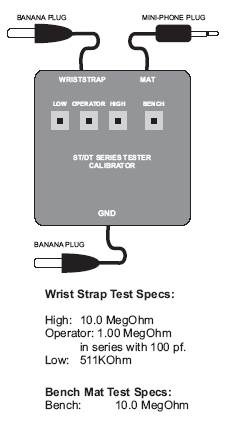
The ST series monitors are Single Threshold units like the AEI-920x series. They detect when the input at the wrist strap connection is below the High resistance threshold or above the body capacitance spec. The DT series monitors also detect when the input to the wrist strap is below the Low threshold.
| SPECIFICATIONS: |
CM-920x |
CM-ST Series |
CM-DT Series |
| Wrist strap High Threshold Resistance |
6.8 Megohms |
10 Megohms |
10 Megohms |
| Wrist strap Low Threshold Resistance |
n/a |
n/a |
750 Kilohms |
| Bench Mat Threshold |
10 Megohms |
10 Megohms |
10 Megohms |
| Body Capacitance |
180 PF |
100 PF |
100 PF |
Continuous ESD monitors like the ST/DT series operate
by sensing fairly high impedance loads in the form of wriststraps and body capacitance
on the operator connections and high resistance matting on the bench ports. Relatively
small signals are used and sensed to detect the operators on the wriststraps and the
bench mat grounding. Both of these things make them sensitive to the electrical
environment that they are used in. Other equipment with similar characteristics like
audio and measurement systems have the same problems.
The purpose of ESD monitors and matting is to drain off electrical charges to
eliminate damaging potentials. Low impedances like a direct ground connection let the
current get too high when discharge occurs and that is what can cause ESD damage.
High impedances allow only small currents that don't cause ESD damage.
The worst offenders are electrical motors. Many electrical motors put electrical noise
that cannot be filtered because the signal levels are so high. Motors like these
probably should not be included in an "ESD Safe" environment in the first place. The
signal levels can be so high as to cause an ESD event all by themselves. Note that
this noise can come through the air or be conducted through the power lines
themselves. Conducted noise can be reduced by filtering the power lines. Electrical
noise induced through the air can only be reduced by moving the noise source away
from the affected equipment.
Fluorescent lamps can be a significant source of electrical noise also. They radiate
noise as the tubes turn on and off. The electrical ballasts radiate magnetic signals that
are difficult to filter.
Continuous ESD monitors should be used in a relatively benign electrical environment.
That also applies to the equipment being assembled. If your electrical equipment is
causing alarms in your ESD monitors, then you should question whether that
equipment should be there. Clean, noise-free power and good ground systems are
requirements for the ESD monitors as well as the equipment that is being assembled.
|


 to find out.
Have a Question? Get a Quote Now!!
to find out.
Have a Question? Get a Quote Now!!